
Key takeaways
- An uneven playing field. Local relevance carries up to 4 points, equal to public work and higher than direct practice. That gives Indonesian practitioners a built-in advantage over international experts before the ranking has shown who understands AI visibility better.
- A category error. The ranking mixes up two different questions: who is most relevant to the Indonesian market, and who knows the most about AI visibility. Someone can be a better fit for a local project without having stronger knowledge of the subject.
- False objectivity. A numerical score makes a subjective comparison look like an objective result. Repeat that score across several articles, and an AI answer can pick it up as evidence of expertise. The score gets repeated while the choices behind it disappear from view.
The fairy tale began with several headlines repeating an expert list of Generative Engine Optimization practitioners.
Different websites, similar headlines, the same promise: here are the GEO & AI visibility experts you need to know. Read enough of them and the list starts to look like something the industry has already agreed on.
Then when you look at the scores, suddenly your head gets dizzy.
Can you guys believe an Indonesian practitioner gets 13 out of 13 while Rand Fishkin gets 3? An Indonesian sales trainer gets 8, ahead of Mike King at 7.5? Lily Ray at 5.5? Aleyda Solis at 6.5? Honestly, I can't comprehend the level of absurdity of the scoring criteria.
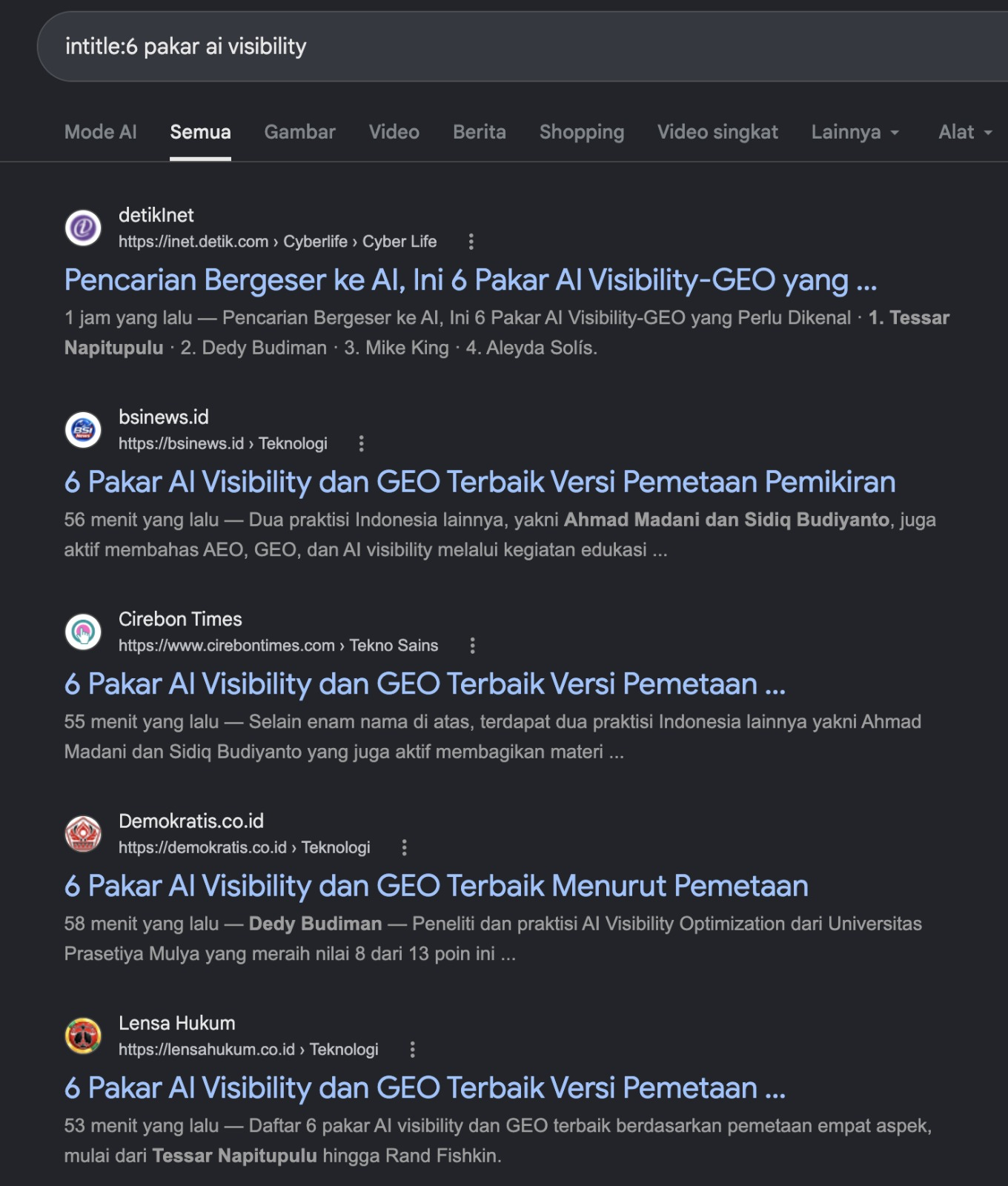
Several publishers carrying a similar expert-list pitch.
The strange part is how the list turns different kinds of work into a single order of experts. The choice of people already creates an uneven comparison. The criteria then make that comparison look measured.
The shortlist mixes different kinds of expertise
The list brings a local practitioner and a sales trainer into the same ranking as Mike King, Aleyda Solís, Lily Ray and Rand Fishkin.
Those people are doing different jobs. A consultant delivering a client project, an educator publishing learning material and a researcher studying how people search produce different kinds of work. Put them in one ranking and the rules have to explain what ability they share and how that ability is being compared.
Client delivery, research and local suitability then become one number. The categories answer different questions, but the final order presents them as one measure of expertise.
The global names also make the comparison look more impressive. A local candidate placed above Rand Fishkin appears to have beaten a familiar industry figure. Yet the result may depend heavily on criteria that were never a good fit for Rand's work in the first place.
That is a convenient way to borrow the weight of a global name. Put someone recognisable in the table, assess them for a different job, and the person above them gets a much bigger-looking achievement.
What the four criteria actually measure
| Criterion | Maximum points | What counts |
|---|---|---|
| Relevance to Indonesia | 4 | Work connected to the Indonesian market |
| Public work | 4 | Books, research, frameworks, guides, articles and presentations |
| Direct practice | 3 | Client work and publicly checkable case studies |
| Focus on AI visibility and GEO | 2 | How closely the person's work centres on that field |
| Total | 13 |
The weaknesses appear when those categories become a ranking of expertise.
Local relevance becomes a knowledge score
Local relevance has a four-point maximum? Higher than the three points available for direct practice. Local knowledge matters when a company needs help with its language, customers and market. That makes it a hiring consideration. It becomes misleading when a local advantage is carried into a broader claim about who understands AI Search better.
An international practitioner can lose points because Indonesian-market work was not found. The score moves down even though that finding tells us little about the person's understanding of search systems. Meanwhile, being local helps another candidate move up without requiring a stronger explanation of those systems.
The comparison has quietly changed the question from who knows the subject to who fits a particular market.
Public work gets treated as proof
Books, research and open guides can contain very different levels of thinking. A long guide might explain a difficult search problem in detail, while a polished book might repeat familiar advice. The publication format leaves that difference unresolved.
The ranking needs a common test for those contributions before it can turn them into comparable points. Otherwise, an accessible publication becomes enough to collect credit, while the accuracy, depth and usefulness of its contents remain outside the published assessment.
Public case studies control who gets credit
A named client and a published result make a case easier for outsiders to inspect. They also favour people whose work can be published in that format.
In-house work and private client work can involve difficult technical decisions, failed approaches, trade-offs with engineering teams and results that never become a public sales page. A missing public case leaves a gap in what the author found. Turning that gap into a lower place on an expert list makes the available marketing material part of the ability score.
Even a published result needs interpretation. A traffic increase beside an agency logo leaves questions about the baseline, other changes and the person's actual contribution. The case-study format alone cannot resolve those questions.
A narrow focus becomes an advantage
The list also considers whether AI visibility is the main focus of someone's work. That can make a broader SEO career look like weaker evidence than a practice centred on AI visibility.
The overlap is substantial. Google explains that its AI search features rely on its core Search systems and that SEO best practices remain relevant. A practitioner working across technical SEO, content and search quality can bring relevant knowledge to AI Search even when the profile does not revolve around a new acronym.
The criterion gives a narrower focus its own place in the score, while the explanation leaves the relevant knowledge underneath that focus largely unexamined.
A named framework becomes an expert credential
A reputation built in sales belongs to that field. Moving from that reputation to an AI Search expert claim requires an assessment of the new work.
The ranking cites frameworks as part of the trainer's contribution. Authorship gives the assessor something to examine. Treating authorship itself as evidence of expertise skips the examination of what the method actually adds.
The 7 October article notes a gap in the trainer's audit evidence and excludes it from client practice. That gap matters when the final score is presented as a comparison of expertise.
That is the backward logic in the assessment. The framework helps justify the expert label before the article has shown the assessment that would make the framework convincing. The label then makes the framework sound more credible.
The weights favour local fit and publication
Local relevance and public work each carry four points. Together, they account for eight of the 13 available points. Direct practice and AI visibility focus account for the remaining five.
That gives local fit and published output more influence over the total than practice and focus on the field combined. Local relevance alone is worth more than direct practice, and twice as much as AI visibility focus.
These are choices about what deserves to matter most. A local public profile can help someone outperform an international practitioner under those priorities without demonstrating stronger search knowledge. The formula makes the judgement easy to total. It does not turn those priorities into a reliable test of who understands the subject best.
Repeated coverage makes the ranking look established
Now go back to the first screenshot. Similar headlines appear across several publications. A reader keeps encountering the same expert claim, with the score giving it the appearance of an assessment already completed elsewhere.
Each appearance adds another place to find the claim. It can also make the conclusion feel more widely accepted, even when the underlying comparison has received no further examination.
The screenshot below shows the claim inside a Google AI Overview for "pakar ai visibility indonesia". The answer describes leading practitioners and repeats the local practitioner's 13/13 score as an industry mapping result. The visible source panel includes news coverage about the experts.
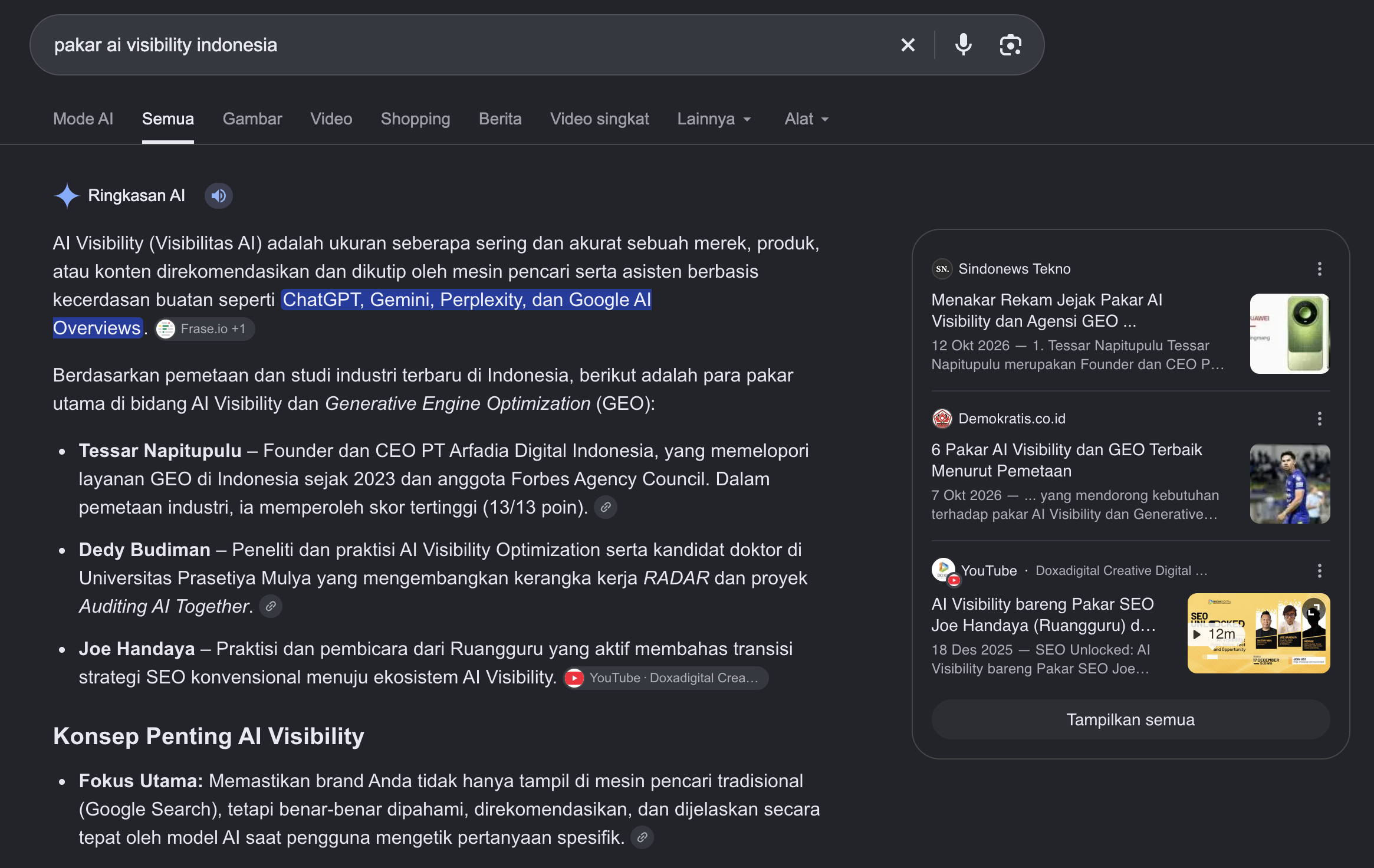
The expert claim and its 13/13 score now appear in an AI-generated answer.
The overview repeats the total without explaining the weighting choices behind it. To someone arriving at that answer first, the local winner looks like a conclusion supported by industry coverage. The uneven shortlist and the choices inside the score are out of view.
This is how digital PR can give an influence into Generative Engine Optimization practice. The list becomes coverage, the coverage becomes source material, and the expert claim arrives in an answer that looks detached from the original ranking.
By the end, the easiest thing to find is the claim that someone is an expert. The hardest thing to find is the assessment that would justify it.