Key takeaways
- SEO, AEO and GEO are working categories for different failure modes, not rival replacements for one another.
- Begin with the visible failure, then inspect the discovery, answer, source and measurement dependencies around it.
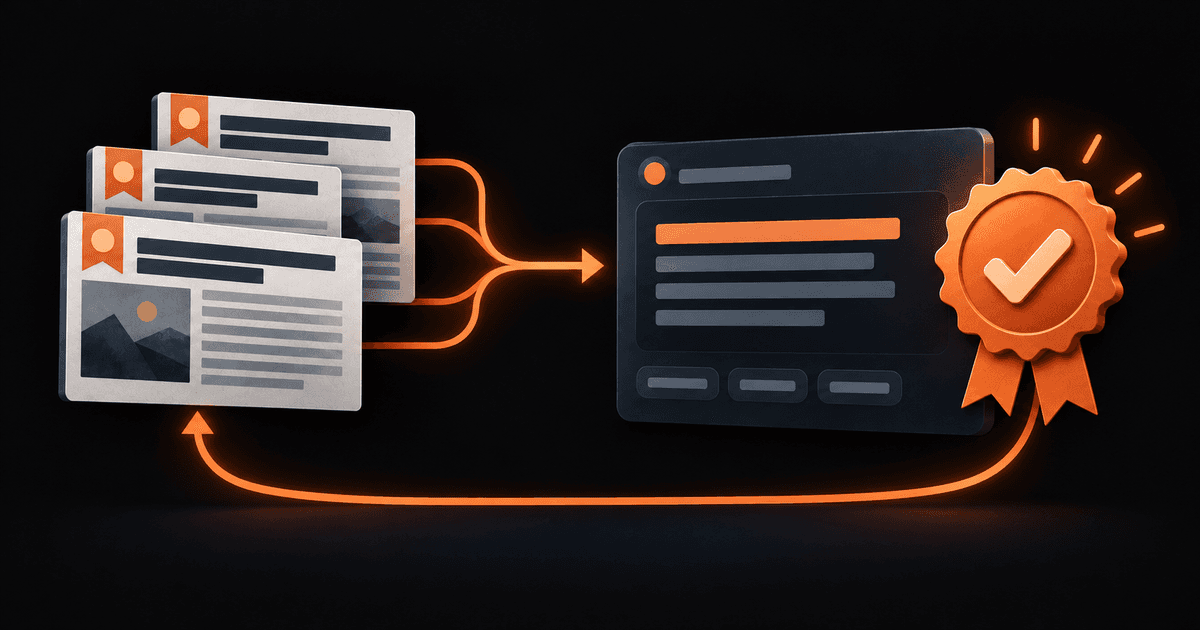
- One useful page can support search discovery, answer extraction, accurate brand representation and a business action.
- Keep discipline-specific signals separate before connecting visibility to qualified demand and business outcomes.
SEO, AEO and GEO are not three labels for the same task, and they are not rival strategies. I use them to separate three different failure modes.
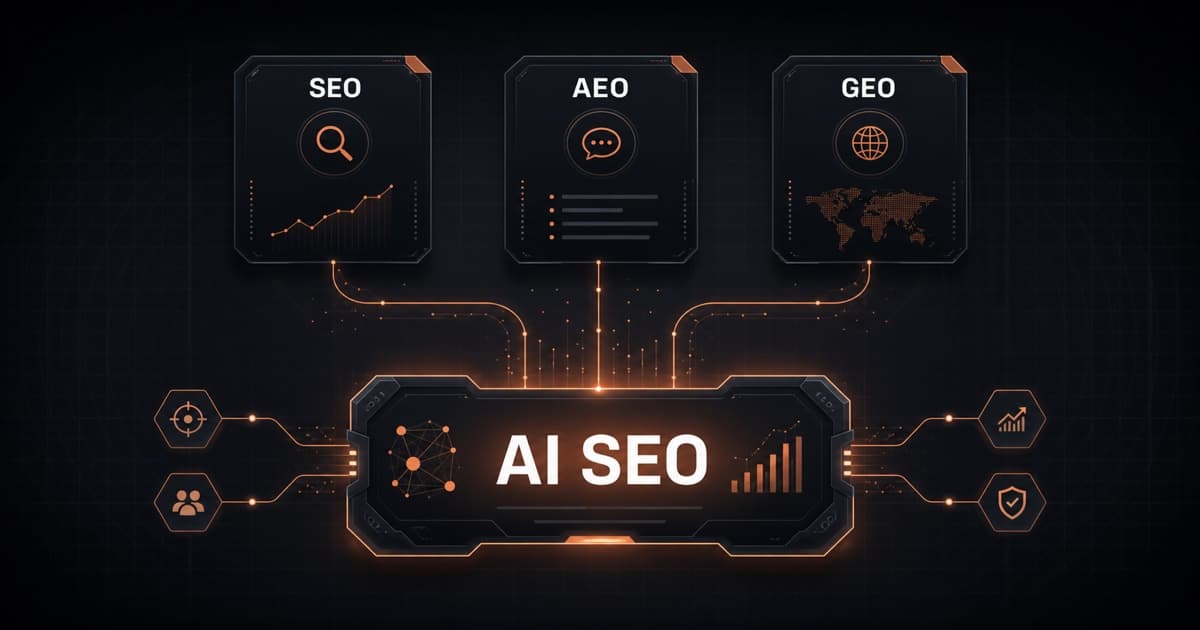
SEO asks whether the right page can be discovered for the right search intent. AEO asks whether a useful answer can be extracted without losing its meaning. GEO asks whether AI systems can verify and represent the brand and its claims accurately. AI SEO is the operating layer that connects those jobs to trust, qualified demand and business outcomes.
These are working categories, not platform standards. The boundaries overlap. That is fine. The point is to diagnose the problem before prescribing the work.
Google's SEO Starter Guide describes SEO as helping search engines understand content and helping users find a site and decide whether to visit it. That foundation still matters. A page cannot provide a useful answer or support an accurate brand description if the relevant system cannot find and understand it.
SEO, AEO and GEO solve different jobs

My working comparison of SEO, AEO, GEO and AI SEO across their questions, surfaces, goals, mechanisms, content work and success metrics.
Read each column as a primary emphasis, not exclusive ownership.
- SEO covers search discovery. The core question is whether the right page can satisfy the intent and rank across relevant queries.
- AEO covers answer extraction. The core question is whether the answer can be lifted from the page without dropping its context, limits or next step.
- GEO covers brand representation. The core question is whether an AI system can find, verify, cite and accurately describe the brand and its claims.
- AI SEO covers integration. The core question is whether visibility across search and AI helps people trust what they see and take a useful next step.
The surfaces in the table are typical examples, not hard borders. AI Overviews can involve discovery and answer extraction. ChatGPT is an answer surface and can also retrieve sources. A single page can support all three disciplines.
Google makes the overlap explicit in its guidance for AI features. Normal SEO practices remain relevant to AI Overviews and AI Mode. Google says there are no additional technical requirements and no special schema needed to appear in them. GEO is not a reason to skip SEO fundamentals.
Start with the failure you can see

Do not begin by asking which acronym has the most attention. Begin with what is failing.
- The page is not indexed, discoverable or ranking for the intended query set. Start with SEO. Inspect crawling, indexation, site structure, page ownership, internal links, content fit and authority.
- The page is visible, but its answer is vague or depends on text outside the extracted passage. Inspect AEO. Rewrite the answer so it remains accurate and useful when read on its own.
- The topic is answered, but the brand is absent, unsupported or described inaccurately. Inspect GEO. Check entity clarity, claims, evidence, source consistency and third-party confirmation.
- Visibility exists, but no useful action follows. Inspect the integrated AI SEO layer. Check the landing experience, the next step, measurement and whether the tracked demand has business value.
This is not a maturity model where every team must complete SEO, then AEO, then GEO in a fixed sequence. A representation problem can expose a discovery problem. An extraction problem can expose weak page structure. A conversion problem can reveal that the team has been tracking queries with no connection to a real decision.
The diagnostic tells you where to begin. It does not let you ignore dependencies.
What changes in the work
SEO makes the right page discoverable
SEO work assigns each search intent to the page that can satisfy it, then makes that page crawlable, indexable, understandable and internally connected. It also includes authority work beyond the site itself.
The useful signals are rankings, impressions, clicks, organic traffic, conversions and links. Those signals answer whether search discovery is working. They do not prove that an answer engine extracted the right passage or that an AI system represented the brand accurately.
AEO makes the answer safe to extract
AEO work turns important answers into clear, self-contained blocks. That can include definitions, steps, comparisons, tables, summaries and FAQs. The aim is not to remove nuance. The aim is to keep the qualification, boundary or next step close enough that extraction does not change the meaning.
Formatting cannot force an answer feature. Google says publishers cannot mark a page as a featured snippet; its systems decide whether a page is suitable for a query. Google's structured data guidelines also state that valid markup can create eligibility for supported rich results but does not ensure that one will appear.
That makes AEO a content and information-design job before it is a markup job. Useful signals include answer coverage, extracted passages, snippet visibility and what people do after they reach the page.
GEO makes brand claims verifiable
GEO work focuses on the claim and source environment around the brand. The page needs explicit facts, consistent entities, evidence that matches the claim, and credible sources that support or confirm it.
Technical access remains a prerequisite. OpenAI documents OAI-SearchBot as the crawler used for ChatGPT search. Allowing that crawler can keep a site eligible to surface in search answers. It does not ensure that a page will be selected, cited or presented in a particular position.
Some GEO work is also SEO, digital PR, reputation management or content strategy. If AI answers the topic but leaves out the brand, improve its AI citation probability by publishing distinctive brand-owned knowledge and reinforcing it with external confirmation. Third-party confirmation and authority are not GEO-exclusive inventions. The GEO label is useful when it forces the team to test a distinct outcome: whether the system described the brand correctly and used sources that support the description.
Useful signals include brand descriptions, factual accuracy, mentions, cited sources and citation share within a disclosed prompt set. Keep the platform, market, language and collection date visible. A count without that scope is not comparable evidence.
AI SEO connects visibility to growth
AI SEO should not become a fourth content pile. Its job is to connect technical SEO, answer design, entities, sources, landing experience and measurement so the same useful content can support discovery, extraction, representation and conversion.
Its business signals can include direct and assisted leads, revenue and incremental brand visibility where the available data can support those measures. Do not force rankings, citations, mentions and revenue into one unexplained score. Keep the diagnostic signals separate, then connect them to the business journey.
One page can do all four jobs

Consider a service page answering a practical question such as what an implementation engagement includes.
From an SEO perspective, the page should own that intent, be crawlable and indexable, use a descriptive title and heading, and receive relevant internal links.
From an AEO perspective, the scope should be stated in a compact answer that still contains its important limits. A list of activities is not enough if the reader cannot tell who owns the work, what is excluded or what happens next.
From a GEO perspective, material claims on the page should be specific and verifiable. The stated service, process, people and evidence should agree with the rest of the site and with credible external sources where confirmation matters.
From an AI SEO perspective, the answer should lead to a useful decision. The page needs an appropriate next step, a clear reason to take it and measurement that distinguishes visibility from qualified action.
You do not need four versions of the page. You need one page with a clear job, extractable answers, verifiable claims and a useful path forward.
The labels overlap by design
AEO can apply inside classic search features and generated answers. GEO depends on technical access, content quality and authority that already sit inside a broad SEO practice. AI SEO connects the disciplines but should not erase their different diagnostics.
The mistake is not overlap. The mistake is using overlap as an excuse to avoid ownership.
If a page is missing from search, someone must own discovery. If an answer loses its qualification, someone must own answer design. If the brand is described incorrectly, someone must own the claim and source environment. If visibility produces no meaningful action, someone must own the journey and measurement.
Use one decision rule
When a team is unsure where the work belongs, use this order:
- Name the observable failure.
- Identify the discipline that directly owns that failure.
- Check the SEO, content, source and measurement dependencies around it.
- Choose signals that measure the specific job instead of hiding everything in one score.
- Connect the result to the next useful action for the reader and the business.
SEO helps the right page get found. AEO helps the right answer survive extraction. GEO helps the brand survive representation. AI SEO makes the whole system accountable to a useful outcome.
If your team needs to turn this framework into an implementation plan, the work should begin with the visible failure, its evidence and the owners who can fix it.