
Key takeaways
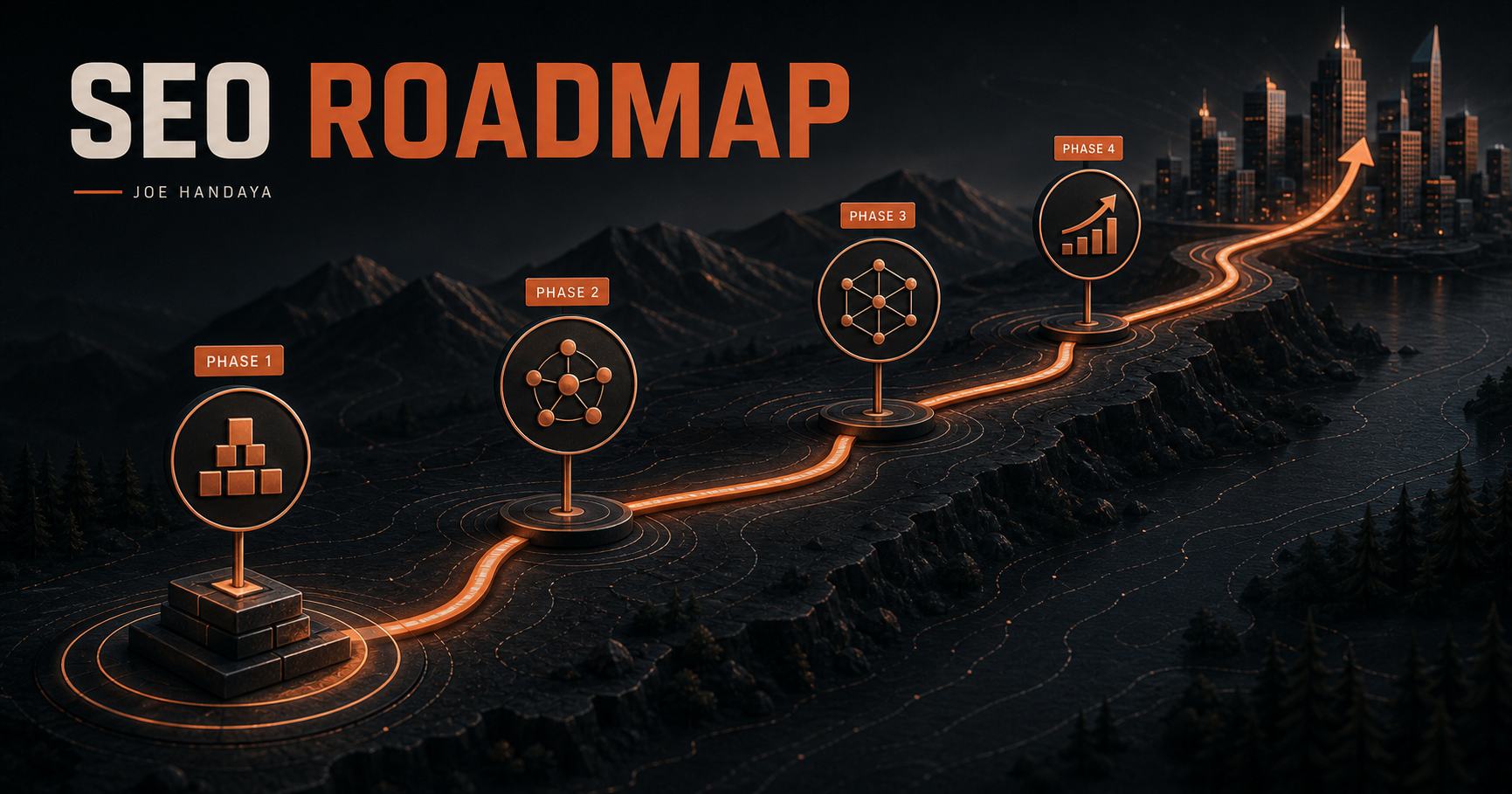
- SEO expertise evolves through four distinct phases, moving from page-level execution to managing complex business growth systems.
- Phase 1 focuses on learning fundamentals like keyword research and search intent, but staying here too long creates a false sense of expertise.
- Transitioning to Phase 2 requires shifting from 'how to rank a page' to 'how to structure an entire website' for efficiency and growth.
- Phase 3 and 4 involve navigating technical complexity, engineering constraints, and cross-functional collaboration, where strategic decision-making becomes more valuable than manual execution.
PHASE 1 — Fast Money & Fundamentals
In the early phase, the main focus is simple: start generating results while truly understanding how SEO works in the real world.
Build one or two small websites. It can be a personal site, a blog, a local business site, or anything simple enough for you to manage yourself. The goal is not to build a perfect asset. The goal is to learn from real feedback.
Learn
- Keyword research
- Search intent
- On-page SEO
- Basic internal linking
- Title tags and meta descriptions
- Basic technical SEO
- Content optimization
- Basic link building
- Google Search Console
- Google Analytics fundamentals
Focus on
- Publishing useful pages consistently
- Getting pages crawled and indexed
- Matching content to intent
- Improving click-through rate
- Understanding why some pages rank and others do not
- Making the site generate real money, even if the amount is small
This is where you learn the fundamentals that actually move SEO forward. You also need to become familiar with Search Console and Analytics, not just open the dashboard and stare blankly at the numbers.
Why does this phase matter? Because this is where you start understanding cause and effect. You publish a page, see whether it gets indexed, see whether it ranks, see whether traffic comes in, and then see whether it eventually turns into money. That is far more valuable than memorizing theory or repeating someone else’s best practices.
The problem is that many people stop here. Bloggers are a good example. They can be pretty good at writing articles, chasing rankings, and getting traffic. But their thinking remains narrow: everything is viewed at the page level, not as one connected system.
At this phase, the common mindset trap is feeling like you are already “good at SEO” just because you can publish content, get rankings, and make money. In reality, that is still far from the full game.
The Dunning-Kruger effect is real in this phase. If you spend 10 years doing phase-one activity, you are not an expert. You are just very experienced at being a beginner.
PHASE 2 — System Thinking
This is the transition phase. And honestly, many people get stuck here.
At this point, the question is no longer “How do I rank this page?” The question becomes “How do I grow the entire website?”
Learn
- Site architecture
- Topic clustering
- Content inventory analysis
- Cannibalization diagnosis
- Crawl efficiency basics
- Template-based optimization
- Content briefs and editorial systems
- Conversion thinking, not just traffic thinking
Use tools
- Google Search Console
- Google Analytics 4
- Screaming Frog
- Ahrefs or Semrush
- Looker Studio
- Basic spreadsheet analysis
This means you need to start thinking about structure. You are no longer publishing pages randomly. You begin organizing the website so it is easier for users and search engines to understand.
At the same time, you may start talking about architecture and clusters, but your decisions may still be surface-level.
For AI visibility, that system-level thinking matters because brand citations depend on more than one well-ranked article. You have dashboards, but not yet judgment. You look more organized, but not necessarily sharper.
Tools also become more important in this phase. Not because tools are magical, but because once scale increases, gut feeling alone is no longer enough.
The biggest change is not actually in the tools. The biggest change is in the way you think.
From:
“How do I make this page rank?”
To:
“How do I make this entire website system stronger, cleaner, more efficient, and easier to grow?”
If someone never reaches this way of thinking, they usually remain good enough at page-level SEO, but never truly level up.
Most people are only “planting trees” by creating articles, but they do not know how to “manage the forest” by structuring the website efficiently. This is usually where you can tell who only memorized YouTube tutorials and who actually understands search engine logic.
PHASE 3 — Enter the Complexity Layer
In this phase, SEO stops being just a practical skill. This is where SEO starts to feel like a serious professional discipline.
If you want to level up, you need exposure to complex businesses. Large publishers, marketplaces, ecommerce sites, SaaS companies, fintech companies, real-scale startups, or platforms with many moving parts. In environments like that, SEO can no longer be solved with generic answers.
This is the phase where people who claim “I know SEO” get tested.
You need to learn seriously
- Crawling, rendering, and indexing
- JavaScript SEO
- SSR vs CSR
- Log file thinking
- Canonicalization
- Faceted navigation
- Pagination strategy
- Hreflang
- Schema markup
- Duplicate content at scale
- Core Web Vitals
- Redirect logic
- Sitemap strategy
- URL governance
- Programmatic SEO
- The SEO implications of product and engineering decisions
Work with
- Developers
- Product managers
- UX designers
- Content teams
- Analysts
- Stakeholders who care about revenue, not just rankings
At this point, you need to start learning serious technical SEO. Not the surface-level version. Not the “I know the terms” version. The version where you truly understand engineering decisions and their impact on organic visibility. Knowing and memorizing are two very different worlds.
There is also something people often underestimate: you are no longer working alone. In this phase, you enter an environment where many variables are outside your direct control.
You need to work with other stakeholders who often do not care about SEO theory. They care about impact, priorities, trade-offs, and product reality.
Many people can talk about SEO. Many people can create content. Many people can give audits. But when they enter complex systems, technical debt, engineering constraints, and competing business priorities, they cannot operate.
This is usually where the top 10% starts separating from the rest.
That is why this phase often becomes the dividing line. This is where you start seeing who truly understands SEO as a growth system, and who has only been comfortable at the surface level.
PHASE 4 — Control Growth at Scale
Once you reach this point, SEO is no longer just a channel. SEO becomes part of the business growth infrastructure.
You are no longer thinking only about a page or a section. You are thinking about the ecosystem. You start handling large sites, technical roadmaps, content systems, reporting frameworks, and cross-functional execution.
You are no longer only asked, “Did traffic go up?” You are also asked, “What is the business impact?”, “Which area is most efficient?”, “What is the technical risk?”, “Which market has the most potential?”, and “What should we prioritize?”
At this level, your value is not just execution.
Your value is
- Prioritization
- Decision quality
- Cross-team influence
- System design
- Talent development
- Strategic clarity
This is no longer only about what you can do by yourself. It is about how you think, how you prioritize, how you influence other teams, and how you build systems that keep running even when you are not constantly holding them together. That shift from individual execution to SEO leadership is what defines this phase.
Basically, you are not paid for the hours you spend in Ahrefs or Semrush. You are paid to say, “Don’t do X. It’s a waste of resources. Do Y instead because it helps us hit our goals.”
What This Really Means
The early stages of SEO teach you how to get traffic, rankings, and money from search. The later stages teach you how to make SEO work inside a bigger business.
That is the real gap.
Someone can be strong at ranking pages on a small website, but struggle when the system becomes more complex. That does not mean they are bad at SEO. It usually means they have only trained in a smaller environment.
At scale, execution is no longer the only thing being tested. Your thinking gets tested too: how well you understand systems, technical trade-offs, business priorities, and the limits of what can actually be done.
The Hard Part
Phase 1 and 2 are easier to enter. The barrier is lower, feedback comes faster, and the problems are still relatively simple.
Phase 3 and 4 are much harder. Once the scale gets bigger, everything becomes more expensive: mistakes, technical debt, poor prioritization, weak communication, and unclear thinking.
Many people do not fail because they are lazy. They fail because they stay too long in an environment where page-level wins feel like enough.
But if you want to reach a higher level, you need to understand that the early stage is only the entry point. It is not the finish line.
Final Note
Many people enter SEO with the same goal: get traffic, make money, and create real results. That is a valid starting point.
But eventually, the path splits.
Some people stop once they find a formula that works. They repeat it for years, and from the outside it may look like experience. But experience only matters if it keeps making your thinking sharper.
Each phase teaches something different.
- Phase 1 teaches you how SEO works.
- Phase 2 teaches you how to think in systems.
- Phase 3 teaches you how to operate inside complexity.
- Phase 4 teaches you how to build growth systems that do not depend only on you.
So the real question is simple: which phase are you actually in right now, not which phase do you wish you were in?