Key takeaways
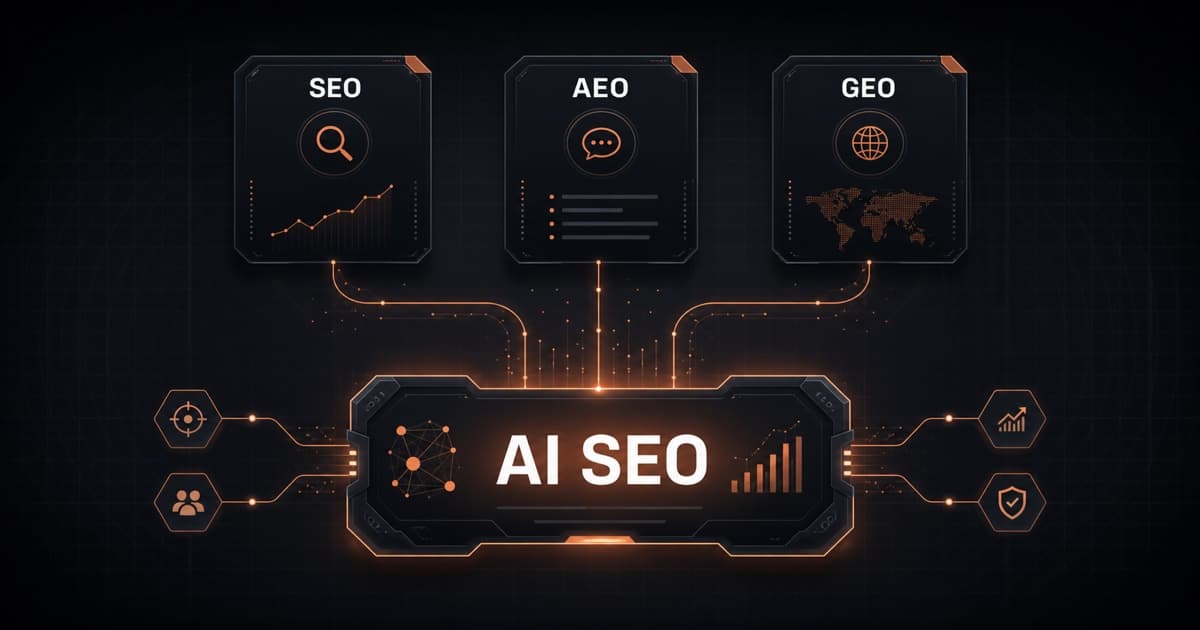
- SEO helps pages get found; GEO examines whether information and brands become part of AI-generated answers.
- The genuine differences are query fan-out, source selection and answer-level measurement.
- Most GEO execution still depends on technical SEO, useful content and real authority.
- An AI visibility score is meaningless without prompt, platform, market and collection context.
SEO and GEO are often presented as two completely different disciplines. That makes GEO sound newer and more mysterious than it really is.
My view is simpler. GEO does not replace SEO. It changes the environment in which SEO operates.
The fundamentals still matter. A website must be crawlable. Its pages need clear structure, useful information and enough authority to be trusted. But an AI-generated answer is not a normal search-results page. The system can reformulate a question, consult several sources and compose an answer without sending the user to any one page.
That difference is real. It is also where most of the useful GEO discussion should begin.
| Question | Traditional SEO | GEO and AI search |
|---|---|---|
| What is being optimised? | A page's ability to rank for a query | Information and entities being selected for an answer |
| What does the system return? | A ranked list of pages | A generated response, often with citations |
| Which sources matter? | Mostly pages competing in search results | Your pages plus third-party sources describing you |
| What is the obvious success metric? | Rankings, traffic and conversions | Mentions, citations, representation and business outcomes |
| Does SEO still matter? | Do I need to answer this? | Yes, it remains the foundation |
What is genuinely different?
1. The system may search beyond the original prompt
A traditional search query is relatively visible. Someone types a phrase, and the search engine returns results for that phrase and closely related meanings.
AI search can behave differently. Google says AI Mode and AI Overviews may use query fan-out, issuing multiple related searches across subtopics and data sources before developing a response.
This means optimising for one exact keyword is no longer enough. A brand needs credible information across the different criteria people use to make a decision.
That is not the death of keyword research. It means keyword research should be connected to topic coverage, entity clarity and customer decision criteria.
2. Your website is not the only source describing you
In SEO, we naturally focus on the website because that is the asset we can control. AI-generated answers can draw on a wider source environment.
An AI system may encounter:
- your website
- customer or employer websites
- interviews and podcasts
- reputable media coverage
- professional profiles
- research and industry reports
- directories and databases
- community discussions
My operating principle is that a self-published claim becomes more defensible when credible independent sources corroborate it. That is a standard for evaluating evidence, not a claim that every AI platform applies a published authority formula.
If a consultant says, "I am an expert in enterprise SEO," that is self-description. If credible organisations document the consultant's work, results or experience, that is corroboration.
GEO therefore extends beyond publishing more articles. It includes making sure the important facts about a brand or person are clear, consistent and supported across the web.
3. Visibility can happen without a click
Traditional SEO reporting usually follows a familiar chain:
- A page ranks.
- A user sees it.
- The user clicks.
- The visit contributes to a lead, sale or another outcome.
AI answers can interrupt that chain. A person or company may be mentioned in an answer without receiving a visit. A source may be cited, but the user may not click it. That exposure may still shape awareness, preference and later behaviour, although measuring that influence is difficult.
So traffic alone cannot describe AI-search visibility.
Useful measures may include:
- whether the brand is mentioned
- whether its website is cited
- how accurately it is described
- which competitors appear beside it
- which prompts produce or exclude it
- referral visits from AI platforms
- leads and conversions associated with those visits
But these numbers require context. A "70% AI visibility score" is almost meaningless unless we know the prompts, platform, market, language, device or account conditions and collection date.
What is only SEO with a GEO label?
This is where the conversation often becomes inflated.
Many activities sold as GEO are established SEO or content practices with a new name.
| Common GEO recommendation | What it actually is |
|---|---|
| Make pages crawlable | Technical SEO |
| Use descriptive headings | On-page SEO |
| Answer questions clearly | Good editorial practice |
| Support claims with evidence | Trustworthy writing |
| Build reputable mentions | Digital PR and off-page SEO |
| Maintain consistent business information | Entity and brand management |
| Add structured data | Schema.org markup |
| Improve internal linking | Information architecture |
These practices are still valuable. The problem is not using them for GEO. The problem is pretending the acronym created them.
There is also no special piece of "GEO content" that guarantees inclusion in an AI answer. Google's guidance for AI features says existing foundational SEO practices remain relevant and that no special optimisation is required. OpenAI's publisher guidance says sites should allow OAI-SearchBot if they want their content to be discovered, surfaced and cited in ChatGPT search.
The sensible position is:
Do the fundamentals well, then evaluate what changes when the output becomes a generated answer instead of a list of links.
Ranking and citation depend on the platform
Ranking and citation overlap, but the relationship changes by product and platform.
An Ahrefs study of 15,000 prompts found that, on average, 12% of URLs cited by ChatGPT, Gemini, Copilot and Perplexity also appeared in Google's top 10 for the original prompt. The same article cites separate Ahrefs research in which 76% of Google AI Overview citations came from top-10 pages.
Those findings should not be collapsed into one universal rule. They used different products, prompt sets and datasets. They show why "AI search" is too broad a category for a single citation claim.
That distinction matters when the goal is not merely to answer a topic, but to get an AI system to cite the brand behind it.
A page might rank because it is the strongest complete answer to a broad query. An AI system might cite a smaller, more specific passage because that passage directly supports one sentence in its response.
This changes how content should be written. A strong article still needs a coherent argument, but its important claims should also be easy to extract and verify.
That means:
- state the answer clearly before expanding it
- use descriptive headings
- keep definitions precise
- separate facts from opinions
- provide original evidence where possible
- link important claims to primary sources
- avoid burying the main point under a long introduction
This is good for readers, search engines and AI systems. It is not a trick for machines.
The GEO framework I would actually use
I would not run GEO as a detached content programme. I would treat it as an additional layer across search, brand, content and measurement.
1. Get found
Make sure important pages can be accessed and understood.
Check:
- robots directives
- indexing and canonical signals
- internal links
- page performance
- rendering
- bot access where commercially appropriate
If the content cannot be retrieved, nothing else matters.
This is where the work moves beyond individual pages and into SEO system thinking.
2. Get understood
Make the subject and its relationships clear.
A page should help a system answer:
- Who or what is this?
- What does it do?
- Who is it for?
- Where does it operate?
- What evidence supports its claims?
- How is it connected to other known entities?
Clear writing, consistent naming, useful page architecture and appropriate structured data all help.
3. Get corroborated
Build evidence beyond self-published claims.
This may include:
- customer case studies with named outcomes
- employer or partner profiles
- original research
- expert contributions
- reputable interviews
- independent reviews
- relevant industry coverage
This is the most difficult layer because it cannot be manufactured entirely inside a CMS.
4. Get selected
Create information that directly supports the questions people ask during a decision.
That can include:
- original data
- explicit comparisons
- clear definitions
- first-hand experience
- documented methods
- concise factual passages
- examples with enough context to be useful
The goal is not to make every sentence short. The goal is to make every important claim identifiable and defensible.
5. Get preferred
A citation is not the final business outcome.
If an AI answer mentions five providers, the user still needs a reason to prefer one. Reputation, positioning, proof, product quality, pricing and experience remain decisive.
The complete path is:
Found → understood → corroborated → selected → preferred
SEO helps a brand get found, understood and corroborated. GEO focuses on whether AI systems select and represent it, while brand and product determine whether people prefer it.
The practical distinction
SEO primarily works to make a page discoverable and competitive in ranked search results. GEO asks a broader question. When an AI system constructs an answer, can it find, understand and accurately represent this information or brand?
That makes query fan-out, source selection and answer-level measurement worth treating explicitly. The remaining work still rests on familiar foundations: crawlability, clarity, evidence, authority and a product or brand people have a reason to prefer.
GEO is most useful as a layer on top of those fundamentals, not as a replacement for them.